
What Is Mapping in Accounting?
Updated
Short answer
Mapping in accounting refers to the process of connecting data fields or accounts from one financial system to another—typically linking subledger transactions to general ledger accounts. It ensures consistency across financial statements, reporting tools, and compliance workflows.
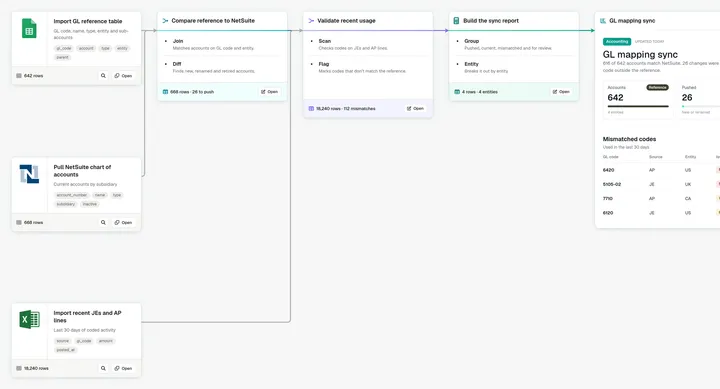
A Prowork Flow can keep a GL mapping reference, compare it with codes in imported ERP or subledger data, and flag missing mappings and differences by entity.
How mapping works in accounting
- Define how source fields or account codes correspond to the general ledger or reporting structure.
- Build a mapping table that links subledger codes to their target GL accounts.
- Validate the mapping on sample transactions. Check that journal entries still balance, totals reconcile to the source, and the classifications are correct.
- Apply the approved rules on import or consolidation, and send unmapped items for review.
Worked example: map subledger categories
A subledger uses a category called “Domestic Parcel.” The mapping table sends it to the parcel-freight expense account in the GL. If a second category has no approved match, hold those rows rather than silently posting them to a generic expense line.
When to review your mappings
Recheck the crosswalk during consolidations, audits, and ERP migrations. A stale or unclear mapping can misclassify transactions, duplicate reporting entries, or leave balances out of the reconciliation.